I Have Found One Missing Piece?
But there are more...

I didn’t step into this study tour as a blank slate. In fact, my curiosity about Aboriginal culture in Australia goes all the way back to high school-over thirty years ago now! Back then, I chose 3-unit Legal Studies just so I could learn about the legal position of Indigenous people and environmental law. Since then, I’ve completed cultural competence training, kept up with the evolving conversations about embedding Aboriginal perspectives in early childhood education, and tried to stay informed about the lasting impacts of colonialism on Aboriginal and Torres Strait Islander communities.
But, if I’m honest, I’ve always carried this nagging feeling deep down: “I just don’t really get it.” I mean, really get it-not just on paper, but in my gut. Despite the encouragement from colleagues and the many resources out there, something about the way I was including Aboriginal perspectives never quite sat right. It wasn’t that the advice was wrong; it was that I didn’t truly understand the pedagogy at its core. How could I, as a non-Indigenous teacher, do this authentically?
Wrestling with Worldviews
After years of reflection, I’ve come to a few conclusions:
My worldview matters. I was socialised in a Western context-one that stands in stark contrast to Indigenous worldviews.
Foundational concepts are missing. I’ve never really been taught, or maybe never fully understood, grounding concepts like Lore and Country. Yet, I’ve been expected to embed perspectives-was I just not listening deeply enough?
Western worldviews tend to focus on science, individualism, and humans as the centre of importance. In contrast, traditional Indigenous worldviews are spiritually oriented, community-focused, and see humans as just one part of Country. When I began my application for the NSW Premier Teachers’ Scholarship, I was driven by a single question: How can I, as a non-Indigenous teacher, socialised in a Western worldview provide culturally relevant pedagogies?
The answer is right there in front of me- kinda!!!
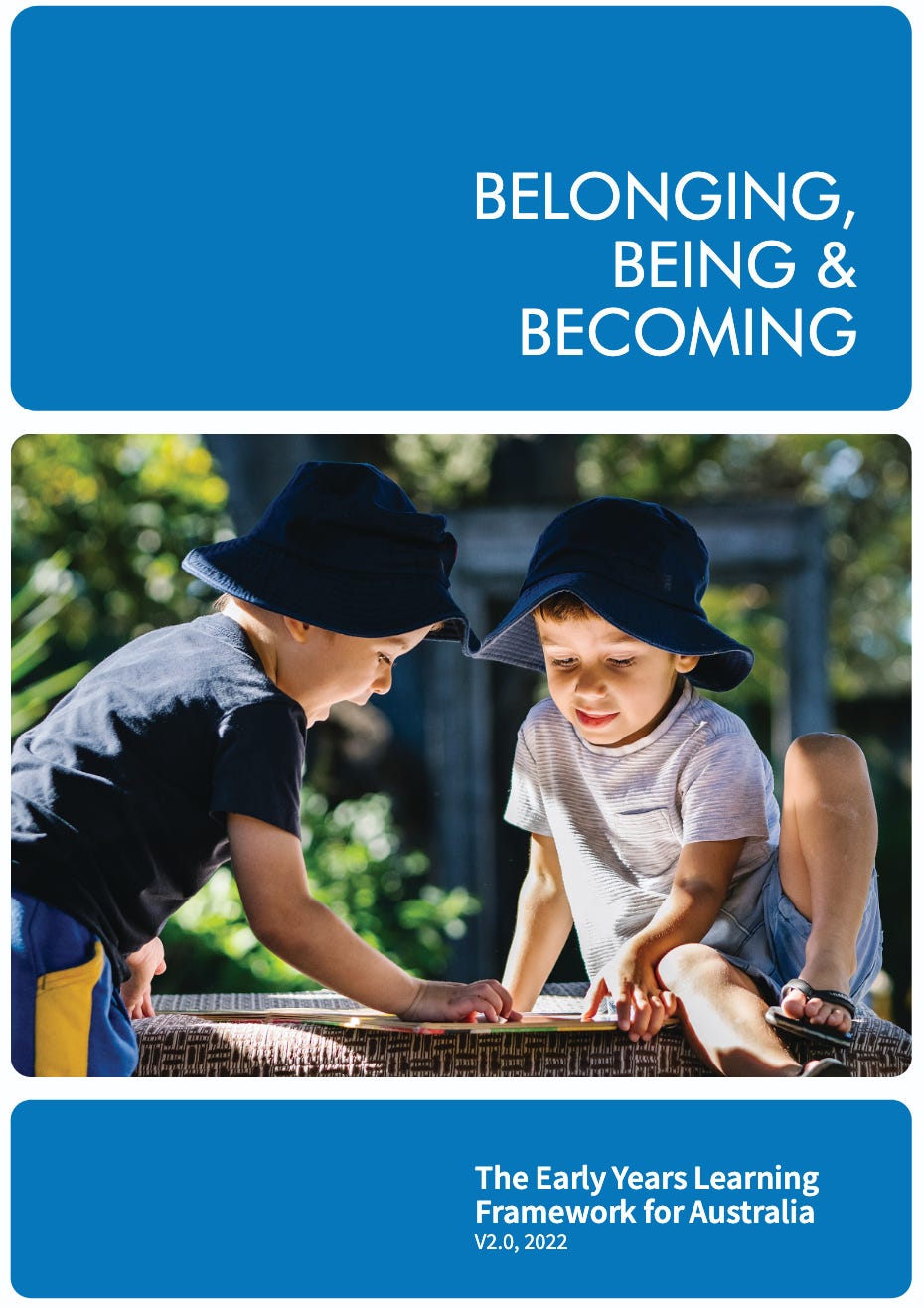
The revised Early Years Learning Framework (EYLF V2.0) has an emphasis on ‘relational’ and ‘place-based’ pedagogies.
Relational pedagogy is all about building trusting, respectful relationships between children, families, educators, and the wider community.
Place-based pedagogy recognises that our knowledge of local context shapes our teaching and that connecting with land and place is especially important for Aboriginal and Torres Strait Islander peoples. This should be explored with local Elders and community members in culturally responsive ways.
but…not all place-based pedagogies are equal!
As I dug deeper into place-based education, I discovered that what the EYLF is talking about is ‘critical place-based pedagogies’- because only critical place-based approaches have two main goals- Decolonisation and Reinhabitation- and those messages are coming through loud and clear in the document.
Decolonisation: Identifying and transforming ways of thinking and acting that perpetuate exploitation or injustice, and centering marginalised voices and knowledge
Reinhabitation: Teaching people how to live sustainably and justly in places that have experienced social and ecological harm, fostering new relationships with land and community
Now, while there’s plenty of approaches that claim to be place-based, there are far fewer examples of critical-place based approaches, and these tend to be more theoretical rather than based on the practical implementation of pedagogy (Yemini et al., 2023).
I want to see critical place-based pedagogies in practice, to understand how I can implement them, how they align with the EYLF V2.0, and, most importantly, to see their impact on children- and hopefully communities!
That’s when I stumbled across the ‘Country as Teacher’ project at the University of Canberra, which was led by David Spillman and Benny Wilson. Suddenly, I felt like I’d found what I’d been searching for-my missing piece. The Country as Teacher leads have said the following,
“We argue that for teachers to be able to appropriately facilitate Country as Teacher pedagogies with students, they must first cultivate their own practice of ‘Relating with Country’.”
The Power of ‘Relating with Country’
Recently, I was lucky enough to attend the "Country as Teacher Symposium." The experience was eye-opening, offering profound insights into integrating Aboriginal perspectives and practices through a very different approach (more about that later!). But for now, I want to focus on just one aspect: the practice of ‘Relating with Country.’
Here’s what I learned:
Personal connection comes first. Teachers need to develop their own practice of relating with Country-connecting with the land physically, intuitively, emotionally, kinaesthetically, and spiritually. This is foundational for learning from Country and ‘getting’ diverse ways of knowing, being, and doing.
One teacher’s Relating with Country experience and impact…
I was hanging out at this gum tree that I love, and over the year I met 25 different species of bird, depending on the time of the year. The gum tree changed colours. I call it the chameleon gum tree now. It's a white one with, you know those white ones with bits of brown on it? It, like after the rain it was khaki and it was pink and then it changed to white again and it was grey on other days. And the leaves changed. Because I was forming this close relationship with the tree. The gum tree was my main focus, but then I started noticing everything around me, the birds, and depending on the seasons, and that's how I could see that there are more than four seasons.
Transformation is possible. Many teachers described transformative learning through direct engagement with Country. They reported greater self-awareness, improved well-being, and a shift towards more holistic, relational education.
Confidence grows. Teachers felt more empowered to engage with Indigenous education practices and to bring these approaches into their classrooms.
What’s Next?
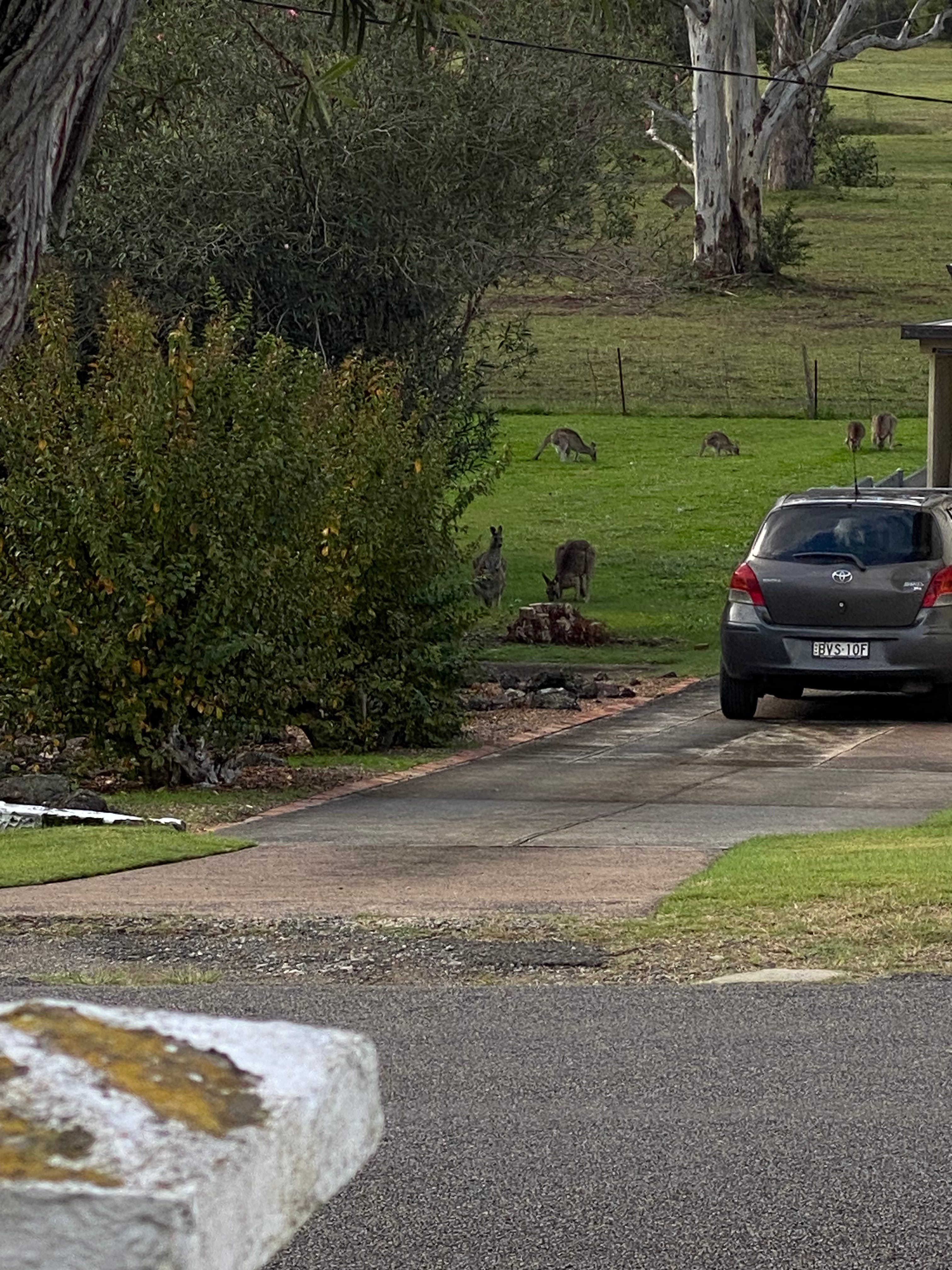
This journey is far from over. But I finally feel like I have a starting point, and so, I continue my own Relating with Country practice…I sit on Wonnarua Country, watching the kangaroos across the road from my place…
.